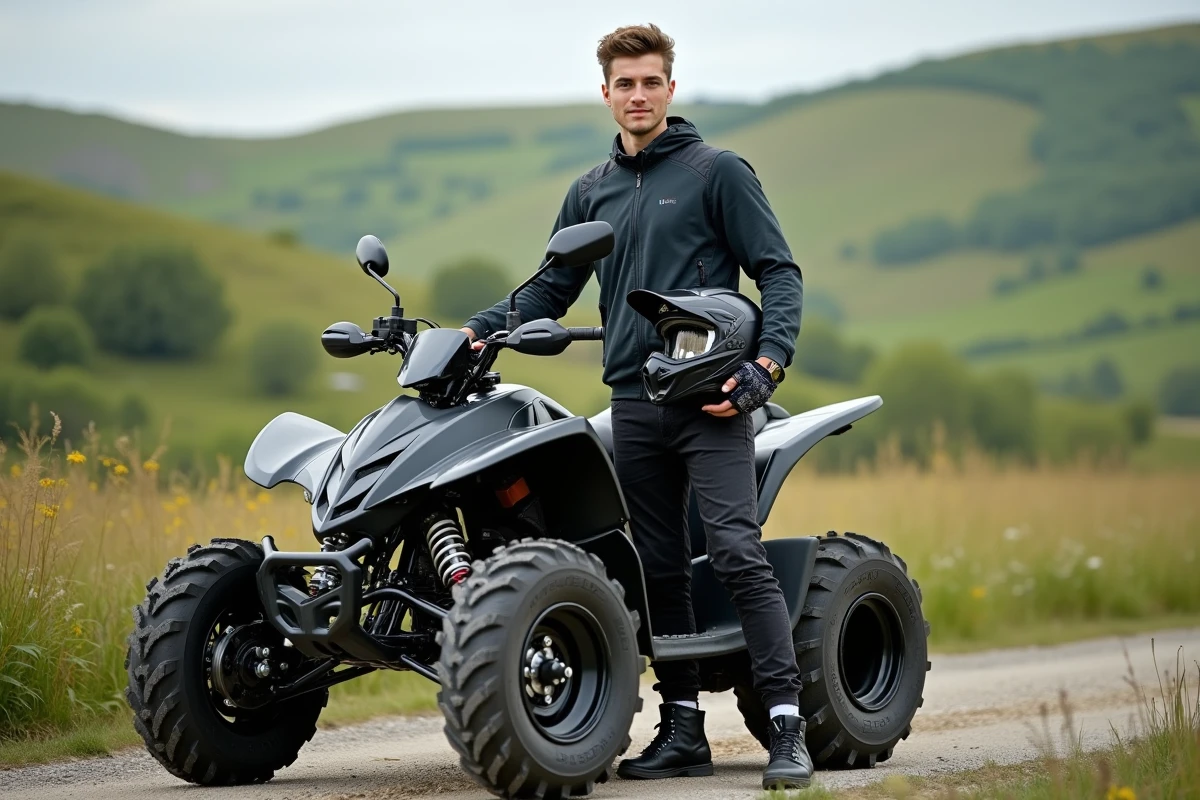
A homologated quad in France with 400cc faces a limit: 80 km/h, not a single kilometer more, except for a few agricultural models strictly limited to 60 km/h. However, on private land or with non-homologated configurations, some easily surpass the 100 km/h mark. But these speed peaks expose riders to unforgiving penalties.
The performance of a quad is not just a number on a technical sheet. The engine, total weight, transmission: everything is interconnected. The discrepancies can be striking between what the manufacturer promises and what the road reveals. And while regulations vary depending on whether you’re riding on asphalt or dirt, many new owners underestimate this complexity.
Maximum speed of a 400cc quad: what the numbers and user experiences reveal
The question of the maximum speed of a 400cc quad intrigues as much as it fuels discussions. Most manufacturer sheets claim top speeds between 85 and 100 km/h. On the ground, the situation changes: a road-legal model remains capped at 80 km/h, restricted by regulations. Off-road, in mud or on dedicated terrain, some enthusiasts report speeds exceeding 95 km/h, freed from administrative constraints.
But reality is not limited to a displayed value. The actual performance of a quad depends on a series of parameters. Engine, load, ground condition, tire quality: everything matters. On rough paths, the search for stability takes precedence, and the maximum speed collapses. Conversely, a long, well-prepared straight line allows for unrestricted use of power.
For those seeking precise data and concrete experiences, the guide on the 400cc quad with Auto l’Hebdo offers comparisons, technical analyses, and numerous testimonials from seasoned users. These accounts drastically nuance the raw figures from the technical sheet. Ultimately, the maximum quad is never just a simple number: it is built on the ground, through mechanics, the nature of the terrain, and the rider’s experience.
What rules govern the speed of 400cc quads in France?
To use a road-legal quad in France, strict regulations are imposed. Only road-legal quads are allowed on the road network, with a maximum speed suited to their category. The “L7e” models, heavy quadricycles with more than 15 kW, cannot exceed 90 km/h. Those classified as “L6e,” light quadricycles, are limited to 45 km/h. Thus, the maximum quad speed arises as much from homologation standards as from engine size.
The quad road code also mandates the wearing of a homologated helmet and certified gloves; quad insurance remains compulsory for all. License B or BSR, it all depends on the driver’s age and the quad‘s power. Off the roads, a private land homologated quad is not subject to the same speed restrictions, but it cannot operate on public roads.
Here are the main requirements to remember for riding legally:
- Mandatory homologation for road use
- Speed limit of 45 km/h (L6e) or 90 km/h (L7e) depending on the category
- Helmet, gloves, and insurance required by law
- License B or BSR required based on engine size
French legislation clearly distinguishes between riding on road and on private land. Driving a 400cc quad on trails or rough terrain changes the game: here, the maximum quad depends primarily on the machine’s technical capabilities and the environment, without regulatory speed constraints.
To go further: resources and tips to better understand quad performance
To analyze the performance of a 400cc quad in depth, much more than a simple maximum speed figure is needed. The power, transmission, and grip of the vehicle form a whole where every detail counts. Experts emphasize adjusting tire pressure according to the terrain type: mud, gravel, dry ground, each variant alters traction and the ability to overcome obstacles.
To grasp all facets of quad performance, it is relevant to rely on feedback from experienced users and on detailed technical analyses. On specialized forums, for instance, discussions can be found about the effects of neglected maintenance, which can lower the maximum engine speed or prematurely wear out the suspensions after a few seasons on demanding tracks. A look through the manufacturer’s manual also allows for reviewing recommendations for oil, chain tension, or brake adjustments.
Practical tips to optimize your quad
Here are some checkpoints to ensure your quad operates at its best:
- Regularly check the condition of the wheels and axles before each outing.
- Carefully maintain the transmission: chain, shaft, or belt, depending on the model.
- Choose a homologated helmet and suitable gloves to ensure your safety.
- Adapt your riding to the topography of the terrain: road, paths, private surfaces.
Fans of motorized mountain biking or UTVs will find valuable resources in technical manuals or from local clubs, which serve as true testing laboratories to optimize performance. Fuel quality, precise ignition settings, shock absorber adjustments: every parameter counts, and mastering your machine makes the difference.
At the end of the trail, the performance of a 400cc quad is not only measured by the speedometer. It is the sum of a well-oiled machine, sharp riding skills, and an intimate knowledge of the terrain that opens up true freedom, one that does not stop at the barrier of numbers.